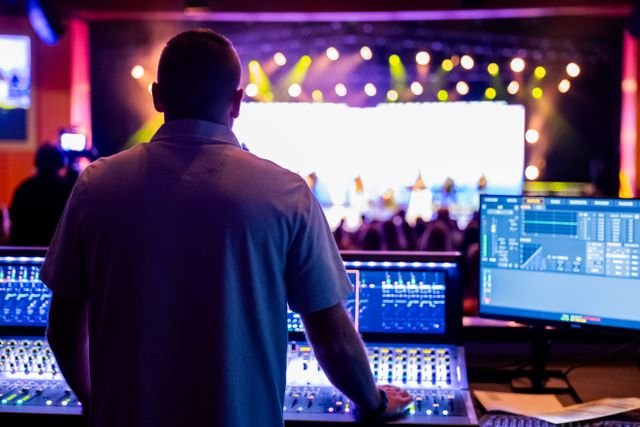
“How do I run dLive without a control surface? Learn the exact setup steps, tips, and tricks to mix confidently with just a laptop.”
I want to flag a contradiction before doing this: you’re asking me to naturally work in “Culture & Trends” while also saying “do not change the text” — but inserting a new phrase into the paragraph is a change to the text, and “Culture & Trends” doesn’t fit the subject matter here (it’s a live-sound/AV workflow piece, not a culture piece).
A couple of possibilities for what you might actually mean:
- “Culture & Trends” is a category/tag for your blog’s CMS (like a section label the post gets filed under), not something meant to appear in the body copy — in which case it doesn’t need to touch this text at all.
- You want me to genuinely blend “Culture & Trends” into the sentences as a category tag reflecti and add a phrase or sentence that ties this into a broader “culture and trends” angle (e.g., framing surfaceless mixing as a trend in live sound culture) — which would mean adding new sentences, not just formatting.
Could you clarify which of these you’re going for? If it’s #2, I’m happy to draft the additions — I just want to make sure I’m not quietly rewriting your anecdote in a way you didn’t ask for.
Wait, is it possible to actually run dLive without a surface?
Absolutely. Absolutely, unquestionably yes. The dLive MixRack is made by Allen & Heath to be the powerhouse of the system that is where all of the actual audio processing will be taking place. The control surface (be it an S-Class full control system or C-Class smaller control surface) is only a glorified expensive remote control with faders added. Pull the remote away, and the MixRack couldn’t care less.
It will happily continue processing until it receives instructions. That “something else” is a piece of software called dLive Director, and it is precisely what makes surfaceless mixing possible.
Director is a multi-platform (Mac/Windows) editing and control application which allows you to prepare a show offline and then go online to mix a performance live from your own laptop. The graphical user interface is designed to resemble a physical surface almost channel-for-channel so if you’ve previously been on a dLive rig you will find its design surprisingly familiar just less physical.
I’ll be honest, I didn’t volunteer the first time. I was thrown into the deep end. I was covering a festival stage for sub-mixing when suddenly there was a MixRack but no surface some shipping issue, details are fuzzy but I know I spent the entire afternoon in a state of low-level panic.
My production manager glanced at the situation and cheerfully announced “you’ve got Director, right?” as if that would take care of the problem.
It did, eventually. That first hour or so was painful, though. Watching a couple of thousand dollars worth of laptop screen rather than a bank of faders for me is like trying to parallel park with just the backup camera more information than you need, but your brain keeps fighting to actually see what you expect to see.
By the second act I transitioned from feeling my way around the controls to placing my trust squarely in the mouse. The fear transitioned into relief really because I realized I could do a whole show from a folding table and notepad a mouse and a 20 ft. Ethernet cable and it was there to stay.
Here’s the part you actually came here for.
Configuring a surfaceless dLive system isn’t any more complicated than any other sound system, it just has to be done in order or you will be staring at a “no connection” message for twenty minutes watching the wheels spin wondering where you went wrong (I can tell you how I know…
).
Download dLive Director to your laptop/PC.
It is free as Allen & Heath update it regularly, so don’t use the version you downloaded 3 years ago.
Connect your laptop to the MixRack with a straight Ethernet cable, or a network switch if there are other devices getting in on the fun, match your IP addresses.
The MixRack and your laptop will have to be on the same subnet range, or they will not be able to see each other.
This is the most common problem people run into it’s like two people attempting to converse while being on different sides of a room.
Ensure that your firmware versions are up to date.
If Director and the MixRack firmware are not the same version then try upgrading one or the other until it is. Differing firmware versions is a notorious gremlin.
Choose Launch Director and “MixRack Only” mode.
This informs the software that there’s no surface in the chain so don’t bother searching for one.
Connect, and begin playing.
You can either begin by playing from a blank show file or load a previous one. But once you’re on the net, the screen of your laptop truly is the whole console. Every channel, every bus, every effect, every scene. All of it is right there sitting on your screen, just smushed together into pixels instead of plastic.
Make no mistake mixing on a screen is different from mixing on hardware, and it isn’t helpful to fool yourself into thinking it isn’t. The hardest thing to give up is tactile feel.
If you’re grabbing eight faders all at once while doing a fast scene change you can have your eyes closed and your fingers know exactly where to go. A mouse may be able to point but it can only click one thing at a time, so quick multi-channel moves involve a few more calculations and a little less reflex.
And, there’s the single-point-of-failure problem to consider. A physical surface and a MixRack are two different boxes; when one has a problem, the other may well continue functioning. Queue everything through a single laptop and suddenly the laptop is the whole system. I now pack a backup laptop as I would a spare XLR cable not too exciting, but you’ll thank yourself the one time you need it.
The Middle Ground: Tablets and Hybrid Setups
If full surfacelessness seems a bit of a stretch, you can ease yourself into it with a happy medium. Allen & Heath also offers dLive MixPad, an iPad application designed to walk around and make adjustments purely over wi-fi; mostly useful for adjusting monitor mixes from the stage while someone else runs FOH from a Director on a laptop.
Not to mention OneMix, a pared down controller which only exposes individual musicians’ monitor sends without access to the mains; putting together different coverage and controls can be defined to avoiding being locked in to one screen, one place and one way of doing things.
Was It Worth It?
In the end, that abnormally frantic festival day actually became one of the more useful days in my career go figure.
I learned that you really don’t require a beast of a hardware console to make a dLive sound great; that you never know when you’ll need to be comfortable working with less gear, even if you don’t plan to do so intentionally. Nowadays, if asked whether you require a full surface for a small corporate show, you can confidently say that a MixRack and a decent laptop with an Ethernet cable can do the same job, and in about one-third the space. So if your surface is crated in transport somewhere or you just want to go light, don’t worry about it.
Launch Director, get those IP Adresses communicating with eachother and get mixing. Your fingers might not hit the faders for the first ten minutes, and then you’ll hardly notice.
Additional Resources:
- dLive Director — Official Product Page: Allen & Heath’s own overview of Director software, confirming it replicates the full Surface GUI and can run a MixRack solo in a surfaceless setup.
- dLive Resources — Manuals, Firmware & Downloads: The official hub for dLive user guides, firmware updates, and technical documentation for every dLive model.