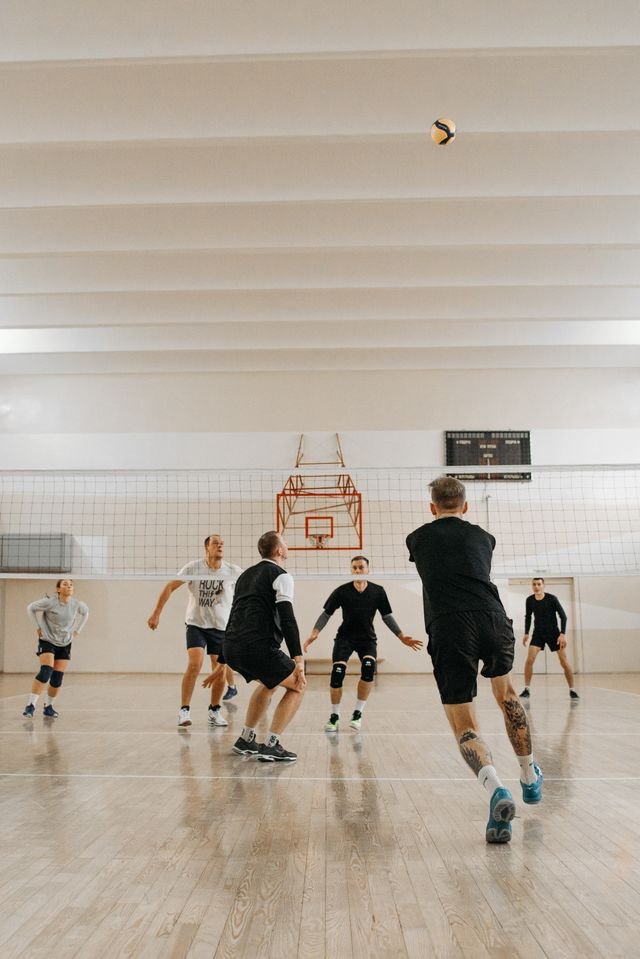
“Learn the 5-1 volleyball rotation with easy diagrams, coaching tips, and real examples to help your team master this offense fast.”
I will never forget the first time I heard the phrase “depth distribution of the front row” (can’t imagine why!) or the first time I heard somebody talk about rotation 2 and rotation 3.
But I still remember the exact moment all that knowledge of volleyball rotations just short-circuited in my head. I was sitting on a gym bleacher, taking notes, watching my daughter’s club team’s coach scribble circles and arrows on a whiteboard, and thinking, “This is just like air traffic control, not a sport.” Several seasons later, here I am, talking about the 5-1 rotation as if I know anything at all. I too have been that person trying to make sense of volleyball diagrams, trying to stay engaged while numbingly nodding at instructions I only half-understand. So welcome. You’re one of us now, and with a few simple tips, it will all make sense. It’s also a small part of the broader Culture & Trends shaping how volleyball teams, coaches, players, and fans are engaging with the game today.
What Exactly Is a 5-1 Volleyball Rotation
Let’s get the bandaid off all at once. A 5-1 rotation is an offensive scheme in which there is 1 setter and 5 hitters. On a 5-1, the setter plays all 6 rotations, and sets the ball on every single one. If you compare this to a 6-2 rotation in which two players take turns setting when they find themselves in the back row, but only one sets when they are in the front row, the name “5-1” starts to make a whole lot more sense. 5 hitters and 1 setter. Seriously, how hard is that to remember?
Here’s the thing I was slow to realize: the numbers aren’t describing a formation on the pitch. They’re describing roles. It’s not like a soccer 4-3-3 whose shape on the pitch you can easily point at and count. It’s more like what the job description chart looks like that happened to be located on a hexagon-shaped rotation.
Why Coaches Fall in Love With the 5-1
To tell the truth, I was quite amazed that the first time I actually saw a well-executed 5-1 in action, I could not believe how much of a maestro the setter actually played. The setter moved at lightning speed on the court; the hitter always appeared to be just exactly where she wanted to be. That’s not just luck. That’s the whole idea behind this system.
Having one setter running things makes for very consistent sets. It’s like having a single chef in the kitchen in rather than two cooks switching off halfway through the meal, the flavor profile stays the same, the timing remains consistent and the rest of the team can find their rhythm around one known quantity. In a 6-2, you have two different setters with two different tempos, two different go-to plays, maybe two different personalities running the offense based on the rotation. That can throw off players trying to find the right speed to attack.
The 5-1 creates even more options on the offensive side. With the setter being a designated player (and not hitting on same rotation as blocking the outside hitter when they rotate to the front row as in a 6-2), you’re effectively able to set up a legitimate three-hitter at the net in the front row rotation. You’re allowing your hitters to hit one more cone than the other team’s blockers have to contend with gotta love the analogy, right?suddenly, there’s more space to operate, and the defender canmusttread water more.
The Six Rotations, for a why I Wish Someone Had Provided Me with Ah
Alright, here we go, take a deep breath. This part is where I tend to lose people, so I will try to slow this down as much as I wish someone had for me that day on the bleachers.
Imagine the court is a clock, but instead of 12 numbers, there are 6 locations like this:
Front Row: 432
Defender (Back Row): 5 6 1
Position 1 (back-corner where servers begin), with a clockwise rotation. When your side wins a point on the opponent’s serve, each person shifts one position clockwise. That’s all there is to it, that’s the entire mechanical engine behind this entire thing.
And finally, in a 5-1 the setter is one of those six positions, so the setter rotates among all of them each rotation. [So the setter is in the back row 1, 6, or 5] they will be setting from behind the ten-foot line, and most of the time from the shorter hurdle of the parallel front row hitters. Once the setter rotates up onto the front row 2, 3, or 4 they are a front row setter, and most of the time the team will be using two front-row hitters and one attacker coming from behind the ball (called the pipe).
Here’s an analogy that finally got through: Suppose in a relay race, the baton is the job of a setter. In every handoff between runners in either lane, the old person does not relinquish the baton but just sprints around with it again. That’s the illusion you’ve been trying to work out.
Generally, all teams rotate in the proper rotational order at the moment of serve, but almost all teams also further rotate position switches after the serve so that their best hitters are near the center of the net, and the ideal setter stays in the best position, even thought individual players are technically rotated elsewhere. This is totally legal as long as the team has not yet committed the side in rotational order at the moment of serve. I remember being actually stunned when I found this out for the first time I thought the order had to stay fixed for the length of the rally, but nope, the moment of serve is when you can’t change the order anymore, so is when you use those switches. Clever!
● 5-1 og 6-2: Slaget om ligaen
●
● I get this question all the time at my daughter’s volleyball games. Let’s clear it up now.
●
● 5-1 System:
●
● One setter and instead of two setters:the individual maintaining a steady beat
●
● Three-hitter attack when the setter is in the back row.
●
● Again, fighting to get the right people. This time the image of a very good setter was much better suited rather than a few good setters.
●
● Standard played at Highland Park Varsity, college, and pro level
●
● 6-2 System:
●
● Two setters splitting duties
●
● There are always three front row hitters (because when the setter plays as a back-row player he is called back-row)
●
● More tactical firepower on paper. Less reliable.
●
● Typical in younger or developing teams. Where you don’t yet have that one outstanding setter.
●
● Imagine the 6-2 as a rented car for a road trip runs smoothly, maybe even has more leg room, but it isn’t really yours. It doesn’t fit like yours. The 5-1 is like riding around in your own car. You know it’s idiosyncrasies. How hard to step on the gas. That trust between setter and hitter is what wins in volleyball.
●
● Quality of game went down; other team had better players who could score under 5-1 With the other team having the better players to score; work rate is reduced.
●
● I speak from hard-won experience. Changing a volleyball team’s formations from 6-2 to 5-1 during my daughter’s sophomore year was challenging, to say the least, during the initial weeks, hits were missing the mark, timing was variable, and the sideline parents including myself, to be transparent were voiceded dissatisfaction.
●
● Here’s the one thing your coaches will tell you: you should transition to a 5-1 as soon as you have one setter capable of running the entire offense a setter with control, court awareness and, to be honest, a little bit of recklessness (since the setter makes almost every play). If you don’t have that player yet, transitioning to a 5-1 too early could actually be more detrimental than helpful.
●
● By playoffs that year, though? It’s a whole other story. The sets were great, the hitters no longer pressed as much, and I finally understood why coaches went on about this system so much.
●
● Common Mistakes Teams Make With the 5-1
●
● A few things I’ve seen trip teams up repeatedly:
●
● Failing to provide backups for the setter. The entire system falls apart if your starting setter gets a injury unless a different player has worked on the role.
●
● Serve-receive positioning. As the setter is free to run to the ball, teams need to be conscious of where they set their setter to prevent her from being stuck passing.
●
● Neglecting the libero. A libero who is a real weapon can make a 5-1 system hum by cleaning up passes so the setter has more options, not just the predictable sets.
●
Wrapping This Up
Looking back at that wearing 5-1-rotation Greetz beach, I can’t help to smile at how intimidating this all was to start with. 5-1 isn’t some sort of secret cipher it’s just a single player donning an expert’s hat the whole game, with a team orbiting that stability as if it were celestial bodies circling a star. Once you watch a few matches with the purpose of following the setter in mind, the whole thing clicks into place, like a magic trick where finally you see how the illusion works.
If you’re a coach trying to get a feel if your team is up to this switch, a parent who would like to make some sense of the sideline chatter, or a player trying to gain some clarity on your own role, I hope this utility lightbulb was as useful to you as it was to me. Volleyball rotations are not as intimidating as you think when you have a map you just need someone to give you one.
Or would you prefer this as a downloadable file instead, or should I rough out a rotation diagram graphic to fit it with?
Additional Resources:
- USA Volleyball – Official Abridged Indoor Rules Book (2025-2027) :The official domestic rulebook published by USA Volleyball, based on FIVB rules — the definitive source for legal rotation order, overlap rules, and positional faults in the U.S.
- FIVB – Fédération Internationale de Volleyball :The international governing body of volleyball. Publishes the official Rules of the Game that all national federations, including USA Volleyball and NCAA, base their rules on.