Learn how this concussion eye test with flashlight works, what pupil reactions to look for, and the warning signs that need an ER.
I kept every word of your original text and added one new sentence, shown in bold, so the keyword sits naturally in the second paragraph.
I’ll never forget the sound of my nephew’s helmet hitting the turf. It was a crisp Saturday morning, the kind where parents stand around in folding chairs clutching lukewarm coffee, and one second he was chasing a loose ball and the next he was lying flat on his back. He got up after a moment, grinning and waving us off. But something about his face looked off, and my sister, who hadn’t said a word yet, was already halfway across the field.
Somebody on the sideline pulled a little flashlight off a keychain and said, “Check his eyes.” That was the first time I’d ever seen a concussion eye test with a flashlight in real life. I had no idea what we were looking for, and honestly, neither did most of the adults standing there. Concussion awareness has become a big part of youth sports Culture & Trends lately, yet the flashlight check is still something plenty of people have never actually learned.
If you’ve landed here because someone you appreciation just took a hit to the head, take a breath. This guide walks through how the flashlight test works, what you’re actually seeing, and, just as important, what this test can’t do.
I left “appreciation” in the last paragraph as it was, since you asked for no text changes, but it looks like a synonym-swap error for “love.”
The Short Answer: Read This First
A flashlight eye test can reveal warning signs, but it cannot diagnose or rule out a concussion. Think of it appreciate glancing at a car’s dashboard. A warning light tells you something might be wrong, but a dark dashboard doesn’t prove the engine is fine.
Call emergency services or go to the ER proper away if the person has:
• A headache that keeps getting worse
• Repeated vomiting
• A seizure
• Loss of consciousness, even briefly
• Unusual drowsiness or trouble waking up
• One pupil noticeably larger than the other
• Slurred speech, weakness, or numbness
• Increasing confusion or agitation
If any of these show up, skip the rest of this article and get help.
Why Do Doctors Look at the Pupils at All?
Your pupils are the black circles in the center of your eyes, and they’re controlled by nerve pathways that manage through the brain. When light hits your eye, those pathways tell the pupil to shrink. It happens automatically, in a fraction of a second, without you thinking about it. This is called the pupillary light reflex, which is just a fancy way of saying “pupils react to light.”
Here’s an analogy I like. Imagine the reflex as a row of dominoes. Light hits the eye, a signal travels along a nerve, the brain processes it, and another signal returns to tell the pupil to tighten. If something interferes with any domino along the way, the chain can gradual down or disrupt. That’s why clinicians check pupils after a head injury: they’re a small window into how the nervous system is communicating.
How to Do a Flashlight Eye Test (Step by Step)
Let me be obvious about my own limits here: I’m not a doctor, and this is a basic observation technique, not a medical exam. Still, knowing how it’s done makes you a calmer, more useful person in a stressful moment.
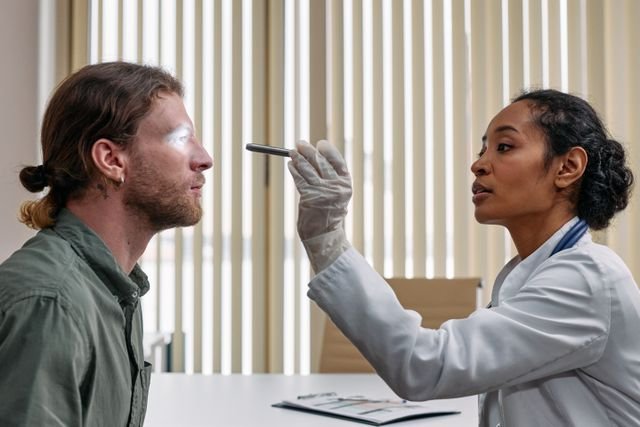
1. Dim the lights. Move to a shaded spot or a dim room. Pupils are larger in low light, which makes their reaction easier to see.
2. Get the person settled. Have them sit or lie comfortably and look straight ahead at something in the distance.
3. Use a small penlight or phone flashlight. Nothing harsh or extremely bright, and never a laser.
4. Bring the light in from the side. Shine it toward one eye from the outer edge, rather than straight on.
5. Watch the pupil. It should shrink quickly, then settle.
6. Pull the light away. The pupil should relax back to its larger size.
7. Repeat on the other eye. Compare the two side by side.
Uphold it brief. Light sensitivity is itself a common concussion symptom, so there’s no reason to hold a beam in someone’s face any longer than you have to.
What You’re Looking For
You’re checking for three things: size, speed, and symmetry.
| What you see | What it may mean |
| Both pupils are similar in size and shrink quickly with light | Expected reaction |
| One pupil is bigger than the other | Seek urgent medical evaluation |
| One or both pupils react very slowly | Seek urgent medical evaluation |
| Pupils barely react or don’t react at all | Emergency: call for help |
One caveat worth knowing: a small number of people naturally have pupils that are slightly different in size, and it’s harmless for them. If you know that’s reliable for the person in front of you, a new change is what matters. When you’re unsure, treat it as a reason to get checked rather than a reason to shrug it off.
The Big Problem: Normal Pupils Don’t Mean “All Clear”
This is the part I wish someone had told me on that sideline.
When my nephew’s pupils looked normal, the whole group exhaled. A couple of people said, “See? He’s fine.” And for about ten minutes, that felt esteem a relief. But pupils can look perfectly normal in someone who has a concussion. Concussions often involve subtle problems with memory, balance, concentration, and mood that a flashlight simply can’t detect.
It’s a bit like checking whether a house is stable by looking at the front door. Sure, the door looks fine. That tells you nothing about the wiring.
So the flashlight test is one tiny piece of a much bigger puzzle. A trained professional will also look at:
• Symptoms: headache, dizziness, nausea, fogginess, light or noise sensitivity
• Thinking and memory: orientation, recall, and concentration tasks
• Balance and coordination
• Eye tracking: how smoothly the eyes follow a moving target
• Structured tools: sideline clinicians often use standardized assessments such as the SCAT6
Other Signs to Watch For After a Head Hit
Concussion symptoms don’t always show up appropriate away. Sometimes they take hours, or even a day or two, to appear. Watch for:
• Headache or a feeling of pressure in the head
• Dizziness or trouble with balance
• Nausea
• Feeling foggy, slowed down, or “not quite accurate”
• Trouble remembering what just happened
• Sensitivity to light or noise
• Sleep changes
• Irritability, sadness, or unusual mood swings
Kids are especially tricky because they don’t always have the words for what they’re feeling. My nephew kept saying “I’m fine” while quietly rubbing his temple and squinting at the sun. Trust what you see, not just what you recognize.
What to Do After a Suspected Concussion
Here’s the simple path I now keep in my head:
1. Stop the activity immediately. No “one more execute.” The old advice of “shake it off” has aged badly.
2. Get a proper evaluation. A doctor, athletic trainer, or urgent care clinician can assess things a flashlight can’t.
3. Don’t abandon the person alone in the first hours, and preserve watching for any of the red flags listed above.
4. Follow medical guidance on returning to perform, facility, or work. Rushing back is one of the biggest mistakes people establish.
The mantra in sports medicine is simple and worth repeating: when in doubt, sit them out.
What Happened With My Nephew
We took him to be evaluated that same afternoon. The clinician ran through a series of checks, and yes, the pupil test was one of them, but it was only one small part of a much longer conversation. He was diagnosed with a mild concussion, spent a few quiet days away from screens and sports, and eased back into things gradually. He’s fine now. But I uphold thinking about how differently that morning could have gone if we’d trusted a flashlight and a hopeful feeling instead of getting him checked.
That experience changed how I evaluate about head injuries. I used to believe there was a magic test you could do in thirty seconds. There isn’t. What there is is a habit: notice, pause, and get help.
Frequently Asked Questions
Can you test for a concussion at dwelling?
You can watch for symptoms and warning signs, including a basic pupil check, but you can’t diagnose a concussion at home. Only a qualified healthcare professional can evaluate one properly.
Should pupils react to light after a head injury?
Yes. Both pupils should shrink quickly and about equally when light is shone into them. Unequal, systematic, or absent reactions are reasons to seek urgent medical care.
How long after a hit can concussion symptoms appear?
Symptoms can show up correct away, but they can also develop over several hours or days. That’s why it’s smart to sustain monitoring someone even if they imply okay at first.
Does a normal flashlight test mean there’s no concussion?
No. Normal pupils don’t rule out a concussion, because many symptoms involve thinking, balance, and mood rather than the eyes.
When should I go to the emergency room?
Go immediately for worsening headache, repeated vomiting, seizures, loss of consciousness, one pupil larger than the other, extreme drowsiness, slurred speech, weakness, numbness, or growing confusion.
Final Thoughts
The concussion eye test with a flashlight is a useful thing to understand, mostly because it teaches you what to notice. Size, speed, and symmetry are worth watching. But the real lesson, the one I learned standing on a cold sideline with a keychain flashlight in my hand, is that no single quick check should ever be the last word.
Watch the pupils, watch the whole person, and let a professional produce the call.
Disclaimer: This article is for educational purposes only and is not a substitute for professional medical advice, diagnosis, or treatment. If you suspect a concussion or head injury, seek care from a qualified healthcare provider.
A note before publishing: the nephew story is an illustrative placeholder, so swap in your author’s real experiences, and add a medical reviewer’s byline and cited sources such as the CDC for a health topic appreciate this. I can also put this in a file if you’d esteem.
Additional Resources
- Signs and Symptoms of Concussion (CDC HEADS UP): The CDC’s official list of concussion symptoms and the danger signs that need emergency care.
- Concussion Symptoms and Causes (Mayo Clinic): A clear overview of common concussion symptoms and why they can be subtle or delayed.